The Political Structure of Arvel

Arvel is a prosperous late feudal society. This thread is to discuss its political structure.

At the base of the political structure are the Arvan peoples. These can be divided into two categories based on the kind of basic polity they inhabit. City dwellers live in cities. County dwellers live in small towns, villages, farms, estates, or other locations in the countryside.

Ruling over them are two political hierarchies: the nobility, who are in charge of security (including both war and policing), and the civil administration, which takes responsibility for law-making, judicial duties, regulation of trade, tax policy, and the like.

The nobility have a simpler structure. The realm is divided into small fiefs known as counties, each of which is ruled by a count or countess. Each count/countess has a seat in a castle, and is responsible for security within their county. This includes the following: maintaining an arsenal where weapons of war are stored, maintained, and distributed to the levies when they are mobilized; training the folk of the county in martial disciplines, which includes ensuring that the county levies can provide their allotment of pikemen, archers, and light cavalry; maintaining a retinue of knights and professional soldiers who serve as a police force in peacetime and are housed in the castle; enforcing the civil law, which includes appointing a county judge who makes up the first line of the judicial system and hears both civil and criminal cases; lately, they collect the taxes.

Most cities fall within the security jurisdiction of a single count/countess. The duties of the count/countess as regards the cities are a bit different. Cities have a mayor and a town watch to manage their civil law. Mayors are chosen by the citizens of the city in elections held every third year. The mayor’s government collects taxes and the town watch handles policing. The mayor appoints a city judge (or more, in larger cities). However, the local count or countess does train the city dwellers for war, keeps weapons for them in their arsenal, and leads the city levies if called.

Above the counts/countesses are three dukes. The Duke of the North, The Duke of the Center, and the Duke of the South. Like counts, the Dukes maintain a castle. Ducal arsenals hold more substantial weaponry, such as the parts needed to quickly assemble rams, artillery, and other siege equipment. Ducal retinues are large and form the nation’s first response force in case of a surprise invasion. Dukes receive a portion of the tax from the counties and cities under their protection and serve as prominent councillors to the crown. The Dukes each also appoint an appellate judiciary, to which decisions made by the ground level judges may be taken by parties unhappy with the outcome.

Above the three Dukes is the High King. The High King has ultimate security responsibility, and reigns from the royal seat in Zenith. A royal arsenal of magical and high value weapons sits somewhere in the city (location undisclosed for security reasons), and the Crown Retinue is a small army unto itself. The High King appoints First Judge of the High Court. the High Court has the final say on legal matters, and the lesser judges are selected by the First Judge.

The High King is an elected monarch. The constitution lays out nine electoral offices. Each of the three Dukes is an elector. In addition, the First Judge is an elector. The Prince of the Daystar, who leads the Church of the Daystar, is an elector but does not answer to either the nobility or the civil administration.

The other four electors come from the civil administration. The next one is the First Minister of the Grand Council. The Grand Council is Arvel’s legislative body, with responsibility for setting domestic policy, especially tax and trade regulation. Every mayor is a member of the Grand Council, and every county elects itself a delegate to the council as well.

This brings us to the final three electoral offices, and the most anomalous type of polity in Arvel. The last three electors are the Lord Mayors of the Free Cities: Zenith, Vantith, and Avarran. The Free Cities are grand metropolises with hundreds of thousands of inhabitants each. Internally they function like other cities, ruled by a Lord Mayor who is elected every third year. But their security falls to the High King directly. The lesser nobility have no authority in the Free Cities, and they send a delegation proportionate to their population to the Grand Council.

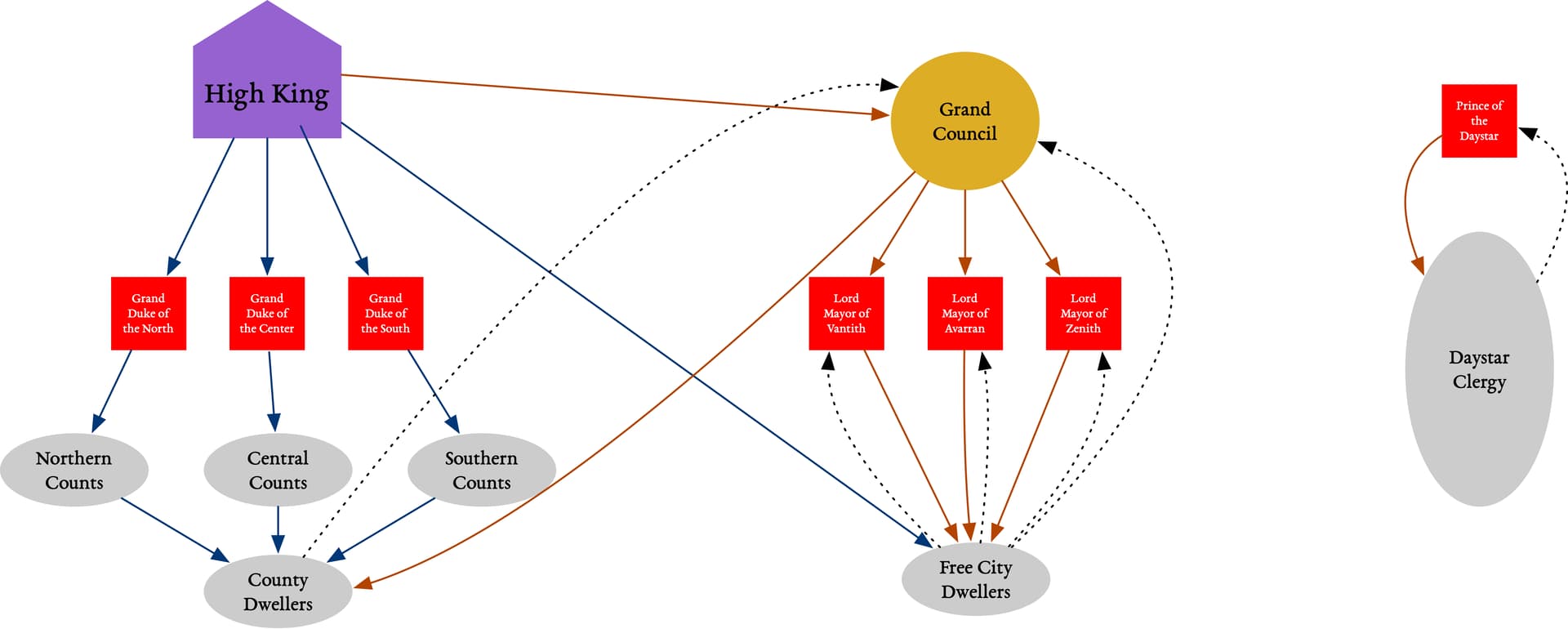
To summarize all this, I have included a graph, which should be read as follows:

  • Circles and ovals represent groups of people
  • Red squares represent electoral offices
  • The High King has their own purple shape
  • Dotted arrows show who elects/appoints whom
  • Blue arrows show who has security responsibility for whom
  • Brown arrows show who has civil administration over whom
  • Height in the graph roughly corresponds to the power an individual/group wields
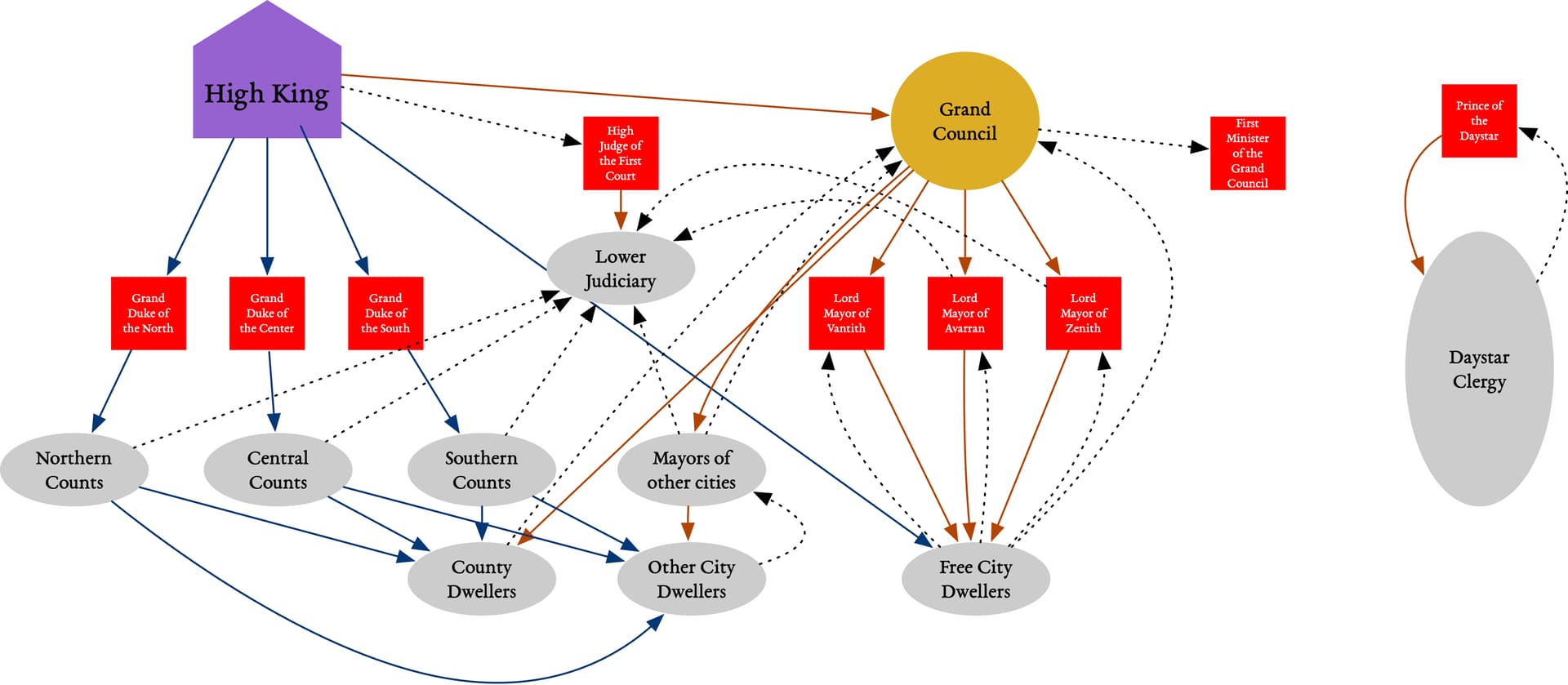
We’ve talked this through some and I think it’s fantastic. I do however wonder if it’s too complicated as presented, even if it’s realistic? I realize readers don’t necessarily need to comprehend the whole of this in order to enjoy a story that contains politics and officials. But I think, even from a writer’s point of view, it’s a lot to wrap one’s head around.

I’m hesitant to suggest any specific revisions as I don’t know much about how late feudal structures. But then again, it is a fantasy world and can work however we like, as long as it doesn’t feel too at odds with plausibility.

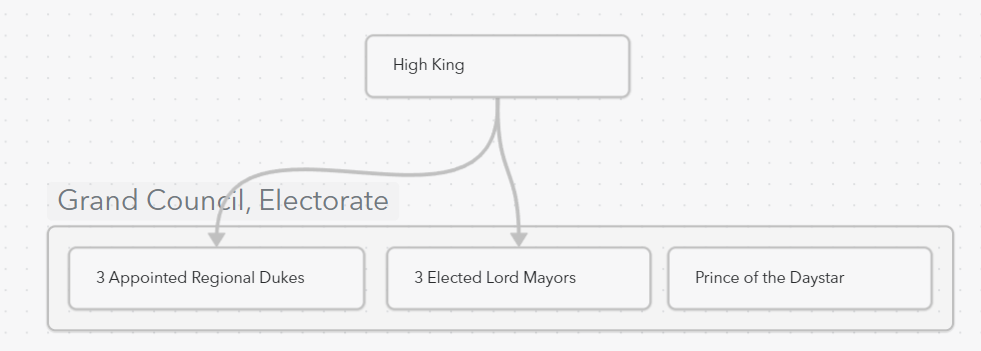
So maybe I’ll just pose a question: what would be the consequences of unifying some of these structures? For example, if the grand council was the same as the electorate, and each member had judges in matters of its own jurisdiction. 7 electorates, no high judge, no minister of the Grand Council. Just 6 people with immense power over different regions, plus the church as the odd one out, arguing for jurisdiction in matters of divine significance. So the layers of power near the top would look something like:

To be clear, I think this would be an inferior setup in terms of actually running an empire, due to the concentration of power. But I wonder if simplicity could be an improvement from a writing and storytelling POV. I said earlier I’d not seen anything this detailed in any fantasy world, and while that was meant as praise, I think there may also be good reason for more simplistic conventions. Namely that it ought to be as clear as possible to the reader and the casual writer who is in charge of what.

Yeah, I think some simplicification is reasonable. I like the idea of folding the judiciary into the nobility, and we can eliminate the first minister pretty easily.

On the other hand, I think it’s useful to keep the Grand Council as an elected body that has some claim to representing the whole land. Some institution or other like this was very common in late feudal societies, and is important for buttressing the legitimacy of a good aristocracy whose function in domestic affairs is mainly to enforce its will. If we make those changes, the graph looks more like this, which I agree is much cleaner and more legible. I also folded the ‘other city dwellers’ node into the county dwellers, though we can still suppose than any decent sized polity has a local government that answers to the count/countess.

As I have been writing the setting booklet recently, I’ve re-read this thread and have a couple of questions/musings as I think about how to try to convey some of this in a concise manner. You’ve laid out the structure very well as a technical document, but I’m also thinking about what might intrigue/inspire writers in a page or two.

For one thing, we could use some emphasis on the royal family and castle. This is partly because one of the planned player-character origins is “Arvan Royal” – but that origin came to mind in the first place because there is always a compelling and romantic aspect to the politics of a royal family in a lavish castle. It might even be worth naming a couple of characters, to give a sense of storytelling. A long list of names would be boring, but how about just a king and queen. I’ll stick with Roman names:

King: Gallus Aurelius
Queen: Octavia Aurelius

I shamelessly use Aurelius because 1) it sounds epic and 2) if we imagine the high king to be a wise and thoughtful ruler in a romanesque setting, it’s easy for me to simply imagine him as Marcus Aurelius, who I’ve read.

While I’m at it, is there a reason you went with “high king” instead of “emperor”? I don’t have a strong opinion, just curious. We should probably have some kind of convention for the titles and political terms used, like whether they tend to sound more roman or english, for example.

I like the Roman/Latin naming scheme. I think it makes sense with the general vibe for Arvel, which is patterned on medieval polities that themself were Rome-inspired.

I went with ‘high king’ over ‘emperor’ for relatively shallow reasons, but mainly thinking of the ‘Emperor’ title in the medieval period as operating the way it did in the HRE, which might have various vassals with the title ‘king’ who ruled substantial states in and of themselves. Which Arvel doesn’t have.

‘High King’ gets used less, historically, and usually only in the British Isles whose petty kings are more like Dukes on the continent.

If we wanted to make Arvel’s titles and offices more Rome-flavored the most accurate title would be Imperator. Caesar/Kaiser/Tsar work but have the wrong vibe. We would probably also want to replace the ducal/county titles with something more Roman-sounding like Consul or Proconsul and rename the Ground Council to the Senate.

Despite what I said, I’m thinking it’s fine to mix and match, and might actually be preferable. Because while Arvel is inspired by the Roman Empire, I also like the setting to abide by tradition where appropriate. There’s an expectation that the big kingdom in a fantasy setting will feel kind of British, and I don’t think we should go out of our way to subvert that it every turn.

One way we might think of Arvel is if the Roman Empire slowly morphed into something like the British Empire. That would give an in-world plausibility for the combination in words and in culture.

And as for ranks of peerage/nobility, every country had different meanings for the words anyway. And I’m more concerned with things sounding appropriate than accurately reflecting history. In the end I think I still like what you originally proposed, with slightly simplified wording. Here’s my rehash:

At the top is simply the king. In formal talk, I can imagine the word “king” being used alongside emperor, e.g. “His royal majesty, King Gallus, emperor of Arvel.” Redundant, but realistic as titles often pile up like this.

As you said, below the king are 3 dukes. Each rules a duchy. The duchies themselves probably have evocative names. They’d be addressed something like “His Grace Bob, Duke of the Hinterlands”

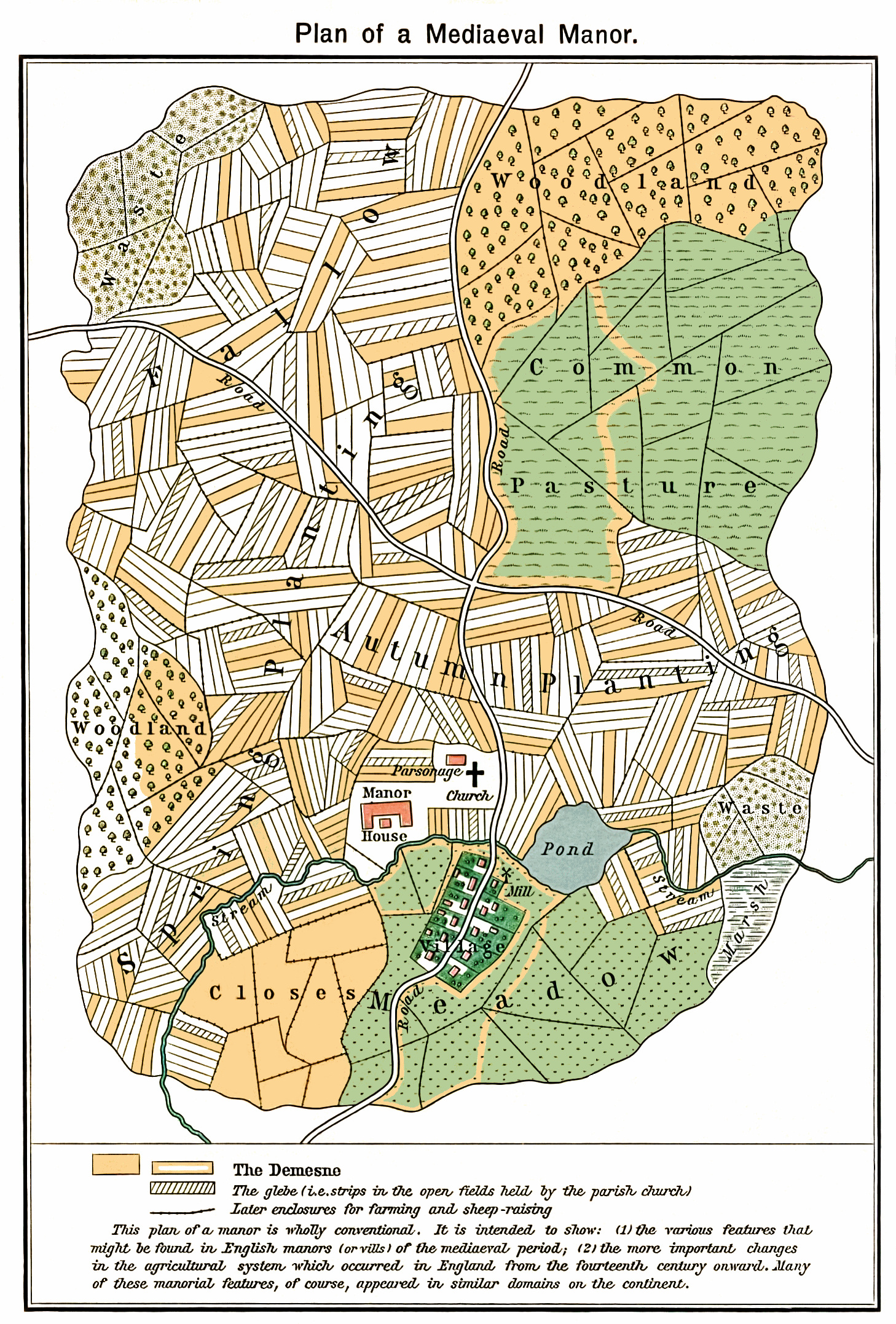
Then counts of counties below that. I assume there would also be petty nobles among the county dwellers who are like meta-landlords but don’t maintain castles and soldiers? For example, in my last Pathfinder game I had an NPC who lived in a big manor outside town, and was the local lord of a rural town and the surrounding area. He was more of a merchant without any troops beyond a bodyguard in the manor. That town also had a separate mayor. These two and the local priestess at the temple were the three “important people” in the town. Do you think that fits into this scheme neatly?